AI in ERP means system of action
The ERP is becoming an AI execution layer

Date
Jun 19, 2026
Author
Priya Krishnamurthy
AI in enterprise systems has moved well beyond experimentation. ERP vendors are embedding AI into the products themselves, and businesses are beginning to use AI to analyse information, recommend actions and automate parts of operational workflows. The next shift is more significant: AI agents are starting to take action on behalf of users.
For finance and operations teams, that changes the risk equation.
An AI system that drafts an email or summarises a report can be reviewed before anything happens. An AI agent that creates a sales order, enters a supplier bill, applies a customer or item match, or triggers a workflow is interacting directly with the financial and operational system of record.
That requires a different standard for trust.
At YosiFlow, we are building AI agents for ERP workflows around that principle. The objective is to give AI enough business context to execute repetitive operational work while keeping the controls, permissions, approvals and accountability that businesses already depend on.
The ERP is becoming an AI execution layer
The direction of travel across the ERP market is clear. AI is increasingly being built into the applications where business data and processes already live.
For NetSuite customers, this creates an interesting opportunity. The ERP already contains the records, relationships, permissions, workflows and transaction history that an AI agent needs to operate with context. The challenge is connecting that context to the high-volume work that happens before a transaction reaches the ERP.
Consider a typical wholesale order.
A customer sends an email with a PDF, spreadsheet or order attachment. Someone needs to identify the customer, interpret the order, match products and customer references, check pricing, quantities, locations and availability, resolve exceptions and then create the transaction in NetSuite.
The ERP may be the system of record, but much of the work required to create a clean transaction still happens outside it.
This is where we see an opportunity for AI agents.
The missing layer is business context
Extracting information from a document is becoming increasingly accessible. Making a reliable business decision from that information is harder.
An order might contain a customer part number rather than the ERP item number. A customer may refer to a warehouse using an internal abbreviation. A supplier invoice may use a different reference format from the purchase order. A new customer may have multiple addresses or trading entities.
The agent needs more than the words contained in the document. It needs to understand how that business operates.
This is why we are building YosiBrain as part of YosiFlow.
YosiBrain provides the shared business memory and context that allows our agents to recognise relationships across transactions, customers, items, locations and previous decisions. That context can then be used to determine whether information can be matched confidently, whether an exception needs attention or whether a transaction is ready to move forward.
The goal is to make the agent progressively more useful as it learns the operating context of the business, while keeping that knowledge governed rather than allowing an AI model to make unexplained decisions.
Governance becomes part of the product
As AI moves closer to transaction execution, governance cannot sit outside the automation.
A useful ERP agent needs to understand what it is allowed to do, what requires approval and when it should stop.
YosiFlow therefore uses confidence levels, validation rules, business context and human approval points as part of the workflow. A high-confidence transaction can move through the process quickly. An uncertain match or policy exception can be escalated to a person. The decision and resulting action remain visible within the workflow.
This matters because finance and operations teams need to answer practical questions about every transaction: What did the agent see? What did it match? What business context did it use? Why did it take that action? Who approved it? What happened in the ERP?
Those questions become increasingly important as the volume of AI-generated transactions increases.
From first-mile work to an AI operating layer
Our initial focus at YosiFlow is deliberately narrow: high-volume, repetitive ERP workflows where teams spend significant time moving information from one system or format into another.
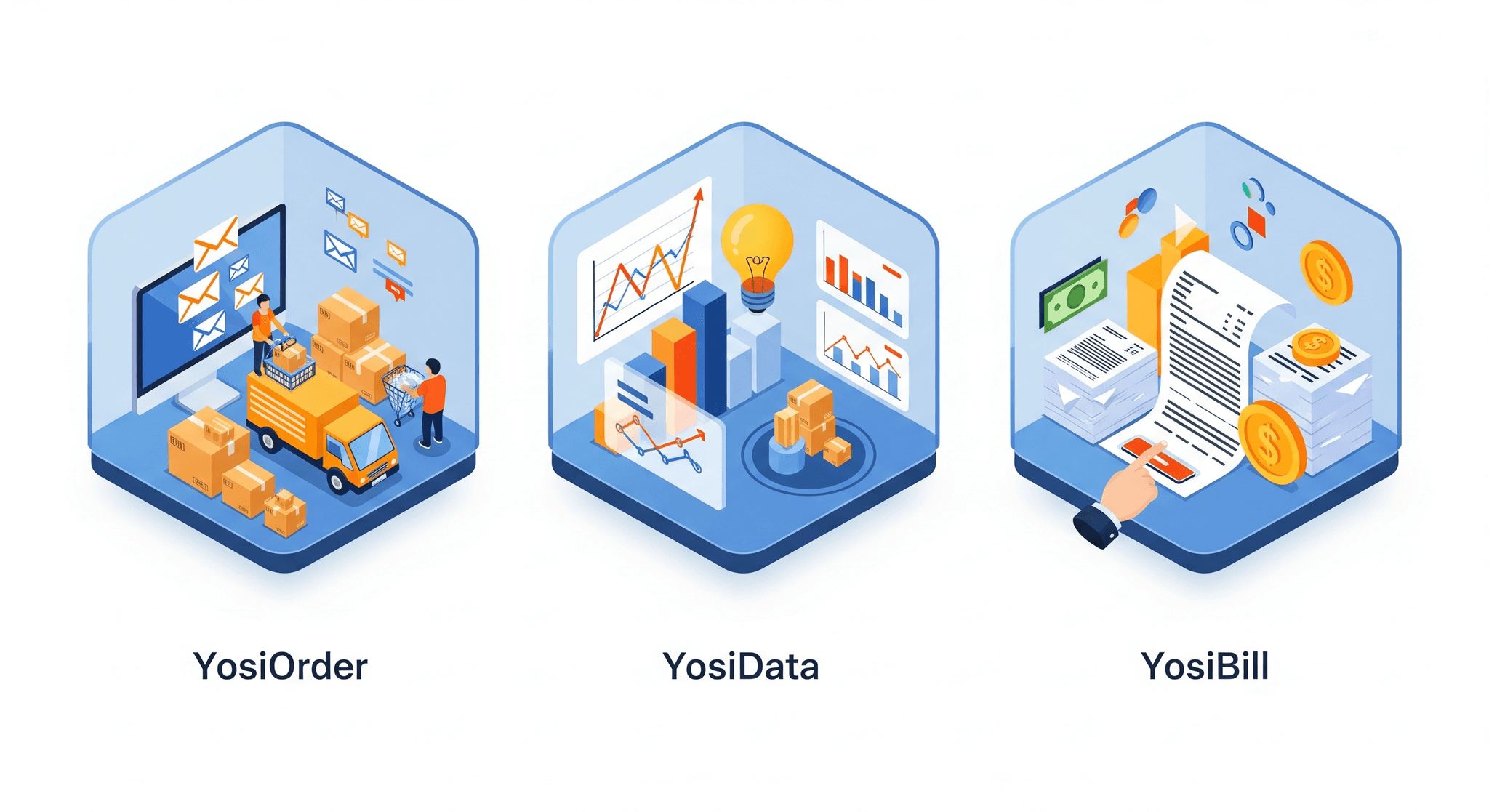
YosiOrder is our first production workflow, automating the first mile of customer orders into NetSuite. YosiBill extends the same approach into accounts payable, where supplier documents need to be interpreted, matched against ERP records and processed according to business rules.
The longer-term opportunity extends across the operational workflows surrounding the ERP, including expenses, freight, margin analysis and other areas where people currently spend significant time interpreting information and performing repetitive actions.
The common architecture is the important part. Each agent operates with access to the business context it needs, follows defined controls, records its actions and knows when a human needs to make the decision.
That creates a very different model for ERP automation.
What finance and operations leaders should be asking
As AI capabilities become embedded in ERP platforms, the question for finance and operations leaders is shifting from whether they should use AI to where they can safely allow AI to act.
The useful questions are practical.
Can the agent access the right business context? Can it distinguish a confident transaction from an exception? Does it operate within existing ERP permissions and approval policies? Can the business see why a decision was made? Can every action be traced back to the underlying transaction? Can a person intervene when the system reaches the edge of its confidence?
These are product design questions as much as technology questions.
AI will increasingly become part of how ERP transactions are created, validated and processed. The businesses that benefit from that shift will need both execution capability and control.
That is what we are building with YosiFlow: governed AI agents that understand the operational context around the ERP, take action where confidence is high, escalate where judgement is required, and keep the ERP as the system of record.
The future of ERP automation is moving from people entering every transaction manually toward people supervising intelligent systems that can execute the work.
The important question is whether those systems can earn the right to act.