Building YosiFlow AI Agents to fix!
The First Mile of ERP Is Broken
Date
Aug 25, 2025
Author
Priya Krishnamurthy
The enterprise software market is at a crossroads. The promise of an ERP is a single source of truth, scale, and unified operations. Yet, for countless businesses, the reality is far from this ideal. For senior leaders and consultants navigating complex ERP migrations and implementations, the very system designed to streamline operations often becomes a grinding bottleneck.
This problem isn't a failure of the core ERP platform itself, whether it's NetSuite or another world-class system—but a fundamental disconnect in the "first mile" of data. This isn’t an ERP problem, NetSuite is world-class but it was never designed for the unstructured, human-first inputs businesses deal with daily and at scale.
While systems like NetSuite provide a robust foundation for financial and operational management, a critical gap exists between a business’s chaotic, unstructured reality and the structured, rigid world of its ERP. This is where countless hours are lost, manual data entry creates human error, and inefficient "shadow processes" thrive outside the system.
The “First Mile” of ERP is a Drowning Problem
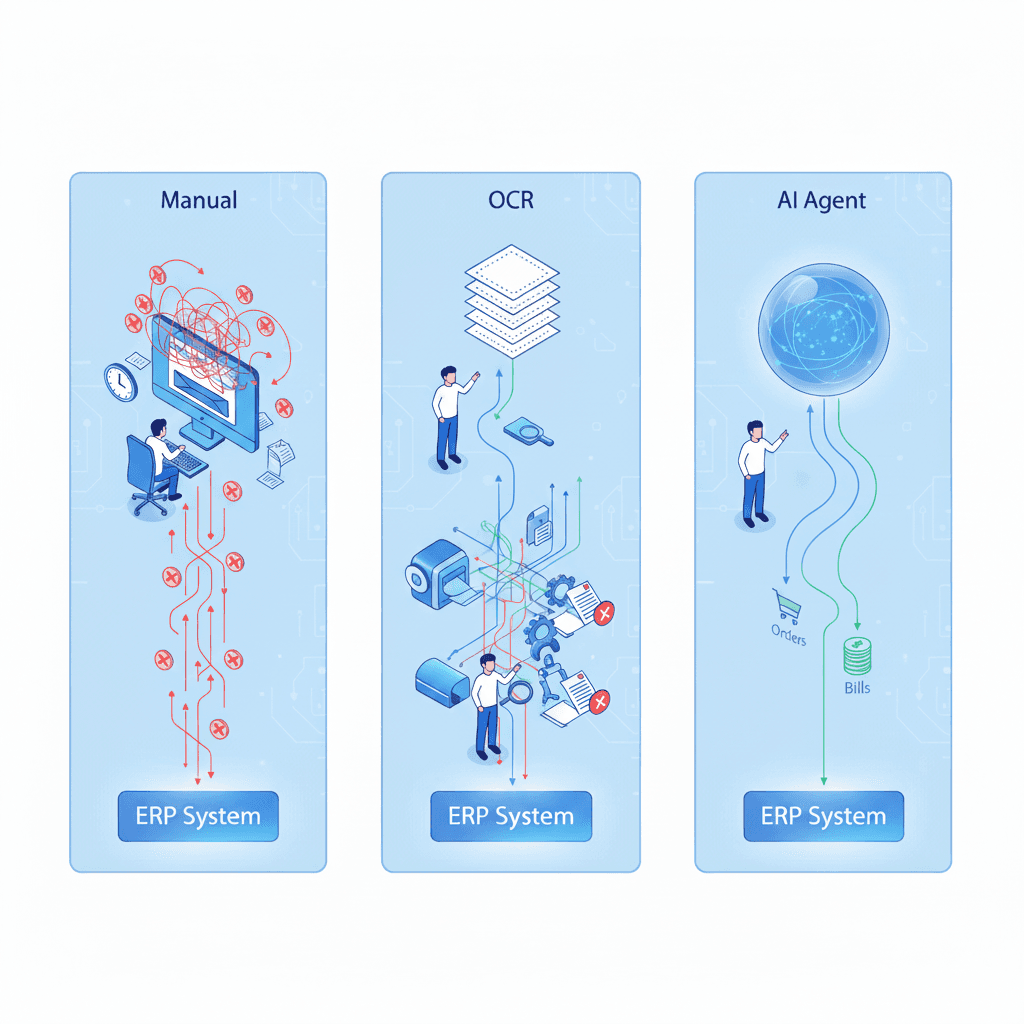
The challenge isn’t a flaw in the ERP’s foundation, but the chaotic, unpredictable stream of emails, PDFs, and external data that must be integrated into it. Companies are often dependent on, or frankly, drowning in, these "first mile" problems.
Sales teams receive new orders via email that must be keyed in manually, delaying fulfilment and frustrating customers.
Accounts payable departments are buried under a flood of digital vendor invoices, draining time from month-end close and damaging supplier relationships.
Crucial business data lives scattered across inboxes and desktops, creating significant compliance risks and audit headaches.
We’ve seen this problem not as an exception but as the unfortunate "norm." The market demands a solution that can bridge this gap without adding new layers of complexity or brittle integrations. The answer isn’t another custom script or a data upload template; it's a fundamental shift in how unstructured data is handled.
When you’re managing cash flow, national operations, and aligning growth goals, the very system designed to help often becomes the source of the grind. How often have you automated a new process only to realize a chunk of exceptions still needs manual intervention?
Why Traditional Automation Falls Short
Traditional automation tools, like the legacy RPAs, are brittle by design. They require perfect design, predictable input which is often pricey and cannot handle the slightest deviation without an ERP consultant. The promise of automation so often falls short in the real world where a business process is a living thing, full of exceptions and ambiguity.
Solving with Saved searches, workflows and SuiteScripts to automate works when the rules are clear and stable, but real business doesn’t work like that.
A customer changes an order after it’s issued, requiring a manual fix.
A supplier sends an invoice with a missing field.
A manager replies “yes” to an approval in an email instead of clicking through a NetSuite workflow.
Rigid logic breaks in these scenarios, teams fall back to manual work, and before long, the ERP is surrounded by inefficient “shadow processes.” These aren’t just a drain on productivity; they create significant audit headaches and data risk, undermining the very purpose of a single source of truth.
This isn’t an ERP problem. NetSuite is a world-class platform, but it was never designed to handle the unstructured, human-first inputs that businesses deal with daily and at scale. The process becomes clunky and breaks down, leading to the ERP feeling less like a solution and more like a tedious chore. Even Oracle NetSuite has acknowledged the urgency by embedding hundreds of NetSuite AI-driven features into its ERP to strengthen reporting, finance, and supply chain workflows. Yet these advances depend on structured data once it’s inside the system.
Introducing YosiFlow: AI Agents for ERP
Through our advisory work at Yosipom, we’ve seen this first-mile pain across industries while advising clients on ERP and NetSuite transformations. It was clear the market didn’t need another brittle integration or middleware layer. It needed a fundamental shift. That insight sparked the creation of YosiFlow.ai—a suite of AI agents built natively for ERP.
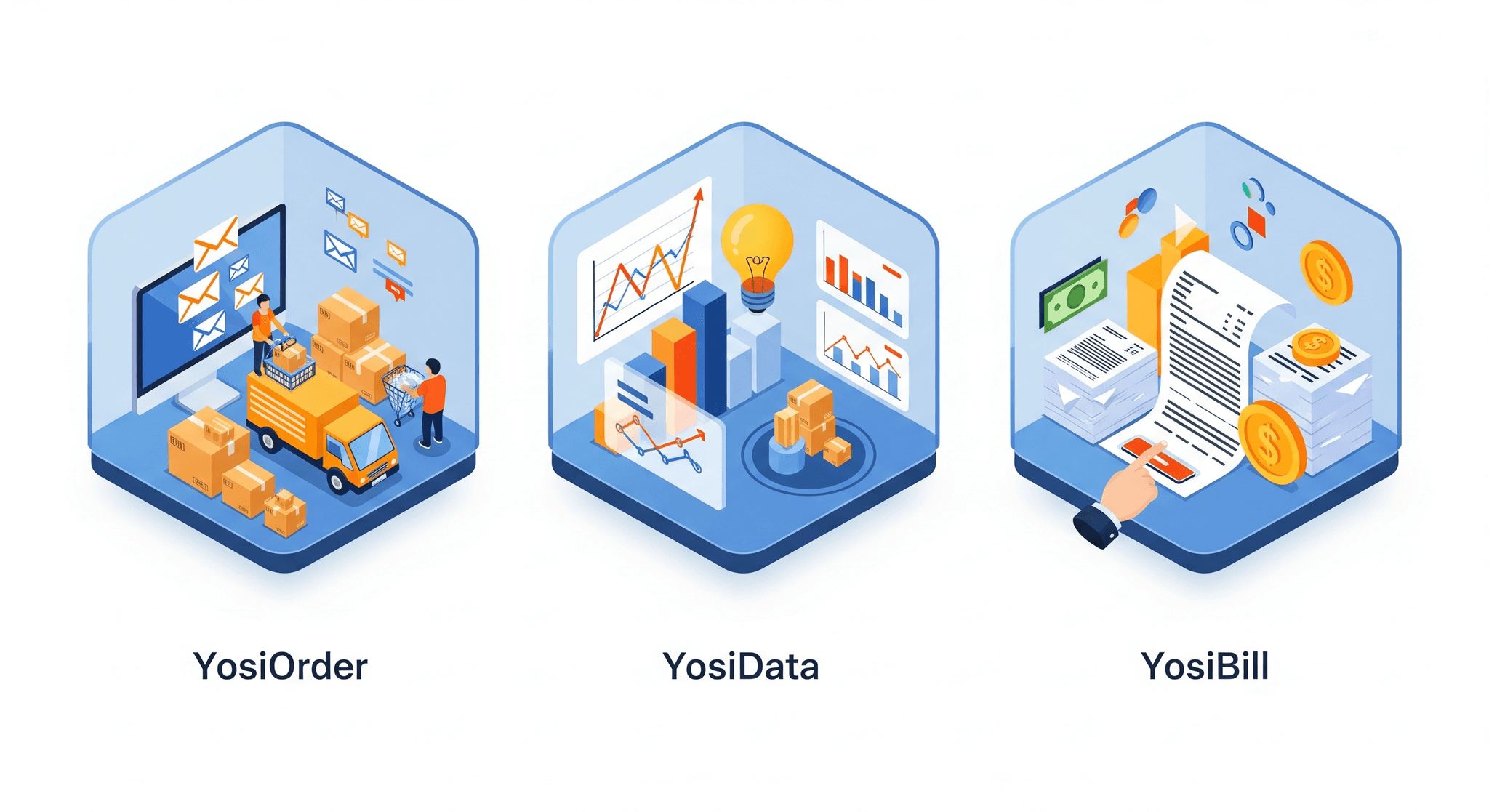
At YosiFlow, we built agents for ERP, starting with solutions purpose-built for NetSuite. Our agents, like YosiOrder and YosiBill, are designed to eliminate the need for manual data entry from mailboxes into the ERP. They reduce the risk of human error yet provide a clear, auditable trail. The difference isn’t just automation—it’s ERP-native intelligence. There is no middleware to manage, no fragile integrations to maintain, and no extra systems to create more work.
Why This Matters for NetSuite Customers & Your Business
NetSuite is already the backbone for thousands of businesses. But its strength and structure can also be its weakness when faced with unstructured inputs. Even Oracle, through NetSuite, is embedding AI deeply into its platform—rolling out hundreds of AI-driven features across finance, supply chain, and reporting. But these advances still depend on structured data once it’s inside the ERP. The first-mile problem—emails, PDFs, and messy human inputs—remains unsolved.
That’s where YosiFlow can help. We provide a solution that is intelligent, seamless, and built for how you actually work. Our AI agents:
Accelerate time-to-value: Go live in days, not months. Our agents connect directly to your system without complex, long-term projects.
Reduce risk & cost: There are no middleware layers to sync or secure, minimizing both your IT footprint and your security vulnerabilities.
Scale effortlessly: As your transaction volumes grow, our AI agents keep pace. There is no need for additional headcount or complex process re-engineering.
It’s the bridge between business reality and ERP structure.
Built for the Future of Business
The next wave of enterprise software won’t just organize data; it will intelligently manage the flow of information. By integrating AI agents directly into your core systems, businesses can achieve a new level of operational maturity.
This transformation allows you to:
Improve efficiency: Automate tedious, repetitive tasks and free up your valuable talent for strategic work that drives growth.
Enhance data integrity: Ensure every transaction is captured accurately and in real-time, eliminating data discrepancies and the need for constant reconciliation.
Unlock new insights: Create a complete, clean dataset for advanced analytics and informed decision-making across the entire organization.
We are bridging the gap to clear the messy reality of business and the structured promise of the ERP. We believe that when systems are truly intelligent, they no longer feel like a grind. They simply YosiFlow.
Ready to tackle your first mile problem in ERP? Let's talk 👉 [Request a call today]